
 EN
EN
 English
 русский
 简体中文
简体中文

Walk into any copper smelter and look at the concentrate arriving at its gate; more often than not, that concentrate exists because of flotation. Copper flotation is a mineral processing method that separates copper-bearing minerals from waste rock by exploiting differences in surface hydrophobicity. Instead of melting an entire mountain of ore, flotation produces a high-grade concentrate containing 20–30% copper from ROM ore with as little as 0.3–1% copper. It is the single most important upgrading step between the mine and the smelter.
The process is conceptually simple: ore is ground to powder, mixed with water and reagents, and aerated in flotation cells. Copper particles are rendered water-repellent by a collector, attach to air bubbles, rise to the surface, and are collected as froth. The gangue stays in the pulp and becomes tailings. Behind that simple description lies a complex system of chemistry, equipment selection, and process control, and that is what this article explains in practical terms.
Why Flotation Works: The Surface Chemistry Principle
Flotation is not about density or particle size; it is about surface chemistry. Most copper minerals are naturally hydrophilic, meaning they are wetted by water. Most gangue minerals, such as quartz and silicates, also have hydrophilic surfaces. To separate them, the flotation process chemically modifies the copper mineral surface so it becomes hydrophobic enough to attach to air bubbles.
This modification is done with collectors, typically xanthate molecules such as sodium ethyl xanthate or potassium amyl xanthate. The collector molecule has two functional ends: one end adsorbs onto the copper mineral surface, and the other projects outward as a water-repellent hydrocarbon chain. After conditioning, the copper mineral particle carries a thin nonpolar coating that allows an air bubble to displace water from its surface and form a stable three-phase contact. The bubble-particle aggregate then rises through the pulp and reports to the froth layer at the top of the flotation cell.
Three forces decide whether a particle will float: the probability of collision between a particle and a bubble, the probability of attachment after collision, and the probability of detachment while rising. Collision depends on turbulence, bubble size, and particle size. Attachment depends on surface hydrophobicity and induction time. Detachment depends on bubble size and turbulence intensity. A well-designed flotation circuit balances these factors so that copper minerals recover quickly while gangue remains in the pulp.
This is why froth, which initially seems like a minor detail, is actually a critical control point. The froth must be stable enough to carry particles out of the cell but not so stable that gangue is entrapped. Froth height, air flow, and frother dosage are constantly adjusted in real time to maintain the right balance. In a copper flotation plant, operators watch the froth color and texture to judge whether the process is healthy before lab assays confirm it.
Copper Ore Types and Their Floatability
Not all copper ore behaves the same way in a flotation cell. The ore type determines reagent selection, circuit design, and expected recovery. The most common copper minerals fall into two categories: sulfide minerals and oxide minerals. Sulfide copper minerals are naturally good candidates for flotation; oxide minerals are much harder to float and often require sulfidization ahead of flotation.
Chalcopyrite (CuFeS2) is by far the most abundant copper mineral and the main target of copper flotation worldwide. It responds quickly to xanthate collectors and is relatively easy to depress from pyrite with lime. Chalcocite (Cu2S) is a secondary enrichment mineral that is even easier to float, but it consumes more collector due to its high copper grade. Bornite and covellite also respond well to conventional flotation. Oxide minerals like malachite, azurite, and chrysocolla do not respond to xanthates alone. They require a sulfidization step with sodium sulfide or sodium hydrosulfide, which creates a thin sulfide film on the mineral surface, allowing xanthate adsorption.
For a plant designer, the distinction matters long before production begins. A copper orebody with a high oxide fraction needs a much more complex flowsheet than a purely sulfide ore, and the flotation equipment must provide longer conditioning times and different aeration control. The table below summarizes common copper minerals and their flotation response.
| Mineral | Formula | Cu Content | Flotation Response |
|---|---|---|---|
| Chalcopyrite | CuFeS2 | 34.6% | Excellent; easy collector adsorption |
| Chalcocite | Cu2S | 79.8% | Excellent; high collector consumption |
| Bornite | Cu5FeS4 | 63.3% | Excellent |
| Covellite | CuS | 66.5% | Good; requires careful pH control |
| Malachite | Cu2CO3(OH)2 | 57.5% | Poor; needs sulfidization |
| Cuprite | Cu2O | 88.8% | Moderate; needs sulfidization |
| Chrysocolla | CuSiO3·2H2O | ~36% | Difficult; often processed by leaching |
Mixed ores containing both sulfide and oxide copper are common in weathered deposits. A typical strategy is to float the sulfide portion first, then sulfidize and float the oxide portion in a separate flotation stage. Some plants use a gravity or gravity-flotation hybrid circuit for coarse liberated oxide particles. In practice, the boundary between the two circuits is defined by a diagnostic analysis of copper recovery in the sulfide stage.
The Complete Copper Flotation Flowsheet: From ROM Ore to Concentrate
A copper flotation plant is not just a row of flotation cells; it is a carefully sequenced system of size reduction, classification, pulp preparation, flotation, and dewatering. Each stage prepares the ore for the next, and a bottleneck at any point immediately drags down recovery. Understanding the full flowsheet is the first step toward selecting the right equipment.
Crushing
Run-of-mine ore from the mine is crushed in two or three stages to reduce lump ore to about 10–15 mm. Jaw crushers and cone crushers are the common choices. The goal is to liberate the copper mineral as early as possible with the minimum expenditure of energy.
Grinding and Classification
Crushed ore enters a ball mill operating in closed circuit with a spiral classifier. The classifier returns oversize particles to the mill and sends fine products to flotation. For most copper sulfide ores, a grind of 60–75% passing 200 mesh (74 μm) is sufficient.
Conditioning
The classifier overflow enters a conditioning tank where collectors, frothers, and pH modifiers are added. Conditioning time ranges from 2 to 10 minutes depending on ore type and reagent solubility. Proper conditioning directly determines the effectiveness of the subsequent separation.
Roughing
Conditioned pulp flows into rougher flotation cells where the first bulk recovery of copper minerals occurs. The rougher concentrate usually goes to cleaner cells, while the rougher tailings may go to scavenger cells for additional recovery.
Scavenging
Scavenger cells are designed to recover copper minerals that escaped the rougher stage. Their concentrate can be upgraded in the cleaning circuit or returned to the rougher feed. Scavenger tailings are usually final tailings.
Cleaning
Rougher and scavenger concentrates are re-floated one, two, or three times in cleaner cells to reject entrained gangue and raise the concentrate to the target copper grade. Cleaner tailings are recirculated to form a closed circuit.
Thickening and Filtration
The final concentrate is thickened in a center-drive thickener, then filtered to reduce moisture to 8–12% before transport to the smelter. Thickener overflow water is recycled to the plant.
This flowsheet is a general framework, not a fixed recipe. A porphyry copper ore with low clay content may need only two cleaner stages. An ore with high pyrite content may require lime depression and a pyrite flotation stage for downstream sulfur recovery. Ore with significant oxide copper needs extra conditioning tanks and a sulfidization unit. The flowsheet always starts with ore characterization.
Selecting the right flotation and grinding equipment is central to the flowsheet design. In a copper sorting plant project in Vietnam, the combination of a wet grid ball mill, a classifier, and a row of mechanical flotation cells achieved the required concentrate grade while keeping energy consumption within the project budget. That is the kind of practical outcome that flowsheet design makes or breaks.
Flotation Reagents: The Chemical Toolbox
Reagents are what make flotation possible. They are consumed continuously during operation, and their dosage and combination usually have a larger impact on recovery than any other factor. A copper flotation plant uses five basic types of reagents, each with a distinct role.
Collectors are the most important class. Xanthates are still the industry standard for copper sulfide flotation. Short-chain xanthates such as sodium ethyl xanthate and sodium isopropyl xanthate are selective and suited for fine-grained ores, while long-chain xanthates like potassium amyl xanthate provide stronger collection power for coarser particles and lower-grade ores. Dithiophosphates and thionocarbamates are sometimes blended with xanthates to improve selectivity against pyrite. Collector dosage in a copper circuit commonly ranges from 20 to 100 grams per tonne of ore, depending on ore grade and mineralogy.
Frothers stabilize the air bubbles in the pulp. MIBC is the most widely used frother in copper flotation, favored for its froth quality and easy control. Pine oil and aliphatic alcohol frothers are also used in plants that generate a natural froth with a large bubble surface area. Frother dosage is small, typically 10 to 50 grams per tonne, but its effect on overflow behavior is immediate and visible within seconds of a dosage change.
Modifiers control the pulp chemistry and the surface charge of minerals. Lime is the most economical pH regulator in copper circuits, keeping the pulp pH in the 9.5–11.5 range to depress pyrite and reduce the risk of unwanted iron recovery. Sodium carbonate is preferred for some oxide ores where lime would precipitate special cations. Sulfuric acid is used in acid circuits, especially in oxide flotation with sulfidization.
Depressants and activators fine-tune the selectivity. Sodium cyanide or zinc sulfate is added to depress sphalerite in copper-zinc ores, while copper sulfate can activate sphalerite in the reverse case. Sodium sulfite or sulfur dioxide depresses pyrite in alkaline circuits. The table below shows typical reagent ranges in a conventional copper sulfide circuit.
| Reagent Type | Example Reagents | Main Function | Typical Dosage |
|---|---|---|---|
| Collector | Xanthates, dithiophosphates | Make copper mineral surfaces hydrophobic | 20–100 g/t |
| Frother | MIBC, pine oil, alcohol blends | Stabilize air bubbles and froth layer | 10–50 g/t |
| pH modifier | Lime, sodium carbonate, sulfuric acid | Control pulp alkalinity, depress pyrite | 500–3000 g/t |
| Depressant | Sodium cyanide, zinc sulfate, sodium sulfite | Prevent gangue and pyrite from floating | 10–200 g/t |
| Activator | Copper sulfate | Promote flotation of activated minerals | 100–500 g/t |
Reagent optimization is not a one-time engineering activity. It must be repeated when the ore blend changes, when the season changes water quality, or when unexpected clay is encountered. A well-run flotation plant keeps a reagent log and a daily review of dosage versus assay results.
Core Equipment in a Copper Flotation Plant
The equipment line directly determines how well the chemical and physical steps of flotation are executed. Grinding, mixing, flotation, and dewatering equipment must match both the ore characteristics and the planned production capacity. Using oversized equipment increases capital cost; using undersized equipment creates recovery losses that are difficult to eliminate later.
Grinding Equipment
The wet grid-type ball mill is the standard primary grinding machine in copper concentrators. It grinds a crushed feed of about 10–15 mm down to a flotation feed of 60–75% passing 200 mesh in one or two stages. The grid at the discharge end controls the pulp level inside the mill and reduces overgrinding. For a copper plant, overgrinding is a hidden enemy because the resulting slimes consume reagents and reduce flotation selectivity.
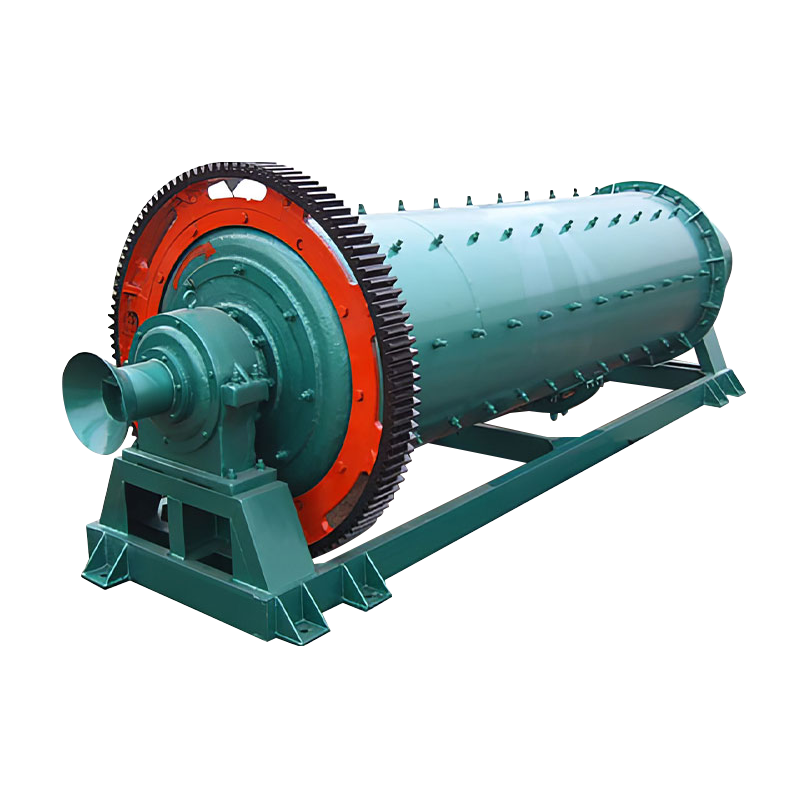
Wet grinding is preferred over dry grinding because it eliminates dust, reduces the risk of oxidation of freshly liberated copper surfaces, and prepares a slurry directly for flotation. The ball mill is usually operated in a closed circuit with a spiral classifier or hydrocyclone. Retrofitting an existing mill with a more efficient lining design or a variable-speed drive is a cost-effective way to gain capacity without buying a complete new mill.
Mixing and Conditioning Equipment
The conditioning stage is often underestimated in plant design, yet it is where reagent-mineral contact actually occurs. A large mixing tank, also known as a conditioning tank, provides the energy and residence time needed for collector adsorption and frother distribution. In copper flotation, the conditioning tank holds the pulp for two to ten minutes before the pulp enters the first flotation cell. The impeller must be powerful enough to suspend coarse particles but gentle enough not to shear the air that is naturally entrained in the slurry.
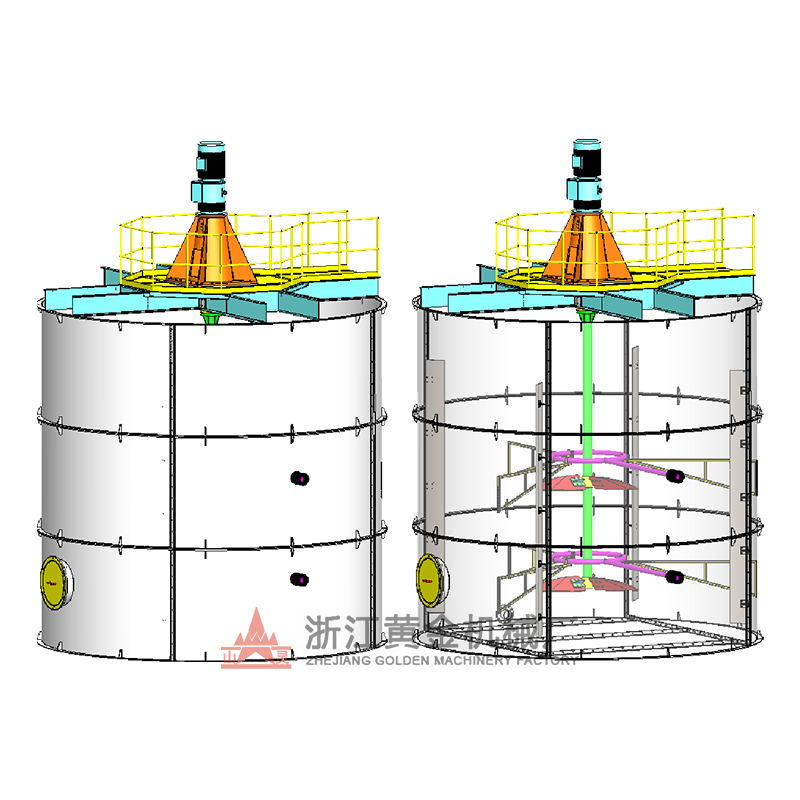
For plants that need to prepare reagents separately, a reagent mixing tank is used to dissolve and dilute collectors and frothers to the desired concentration before feeding them into the pulp. High-concentration mixing tanks are also used in leach circuits and for special applications such as the preparation of flotation tailings for backfill. The mixing intensity, tank volume, and impeller design must be sized together so that the residence time distribution matches the flotation kinetics of the ore.
Flotation Machines
Mechanical flotation machines are the core of any copper concentrator. They consist of a tank, an impeller/stator mechanism, and an air supply system. The impeller creates a recirculation pattern inside the tank, keeping solids suspended while dispersing the air feed into fine bubbles. The froth formed at the surface is removed by scrapers or by natural overflow into a launder.
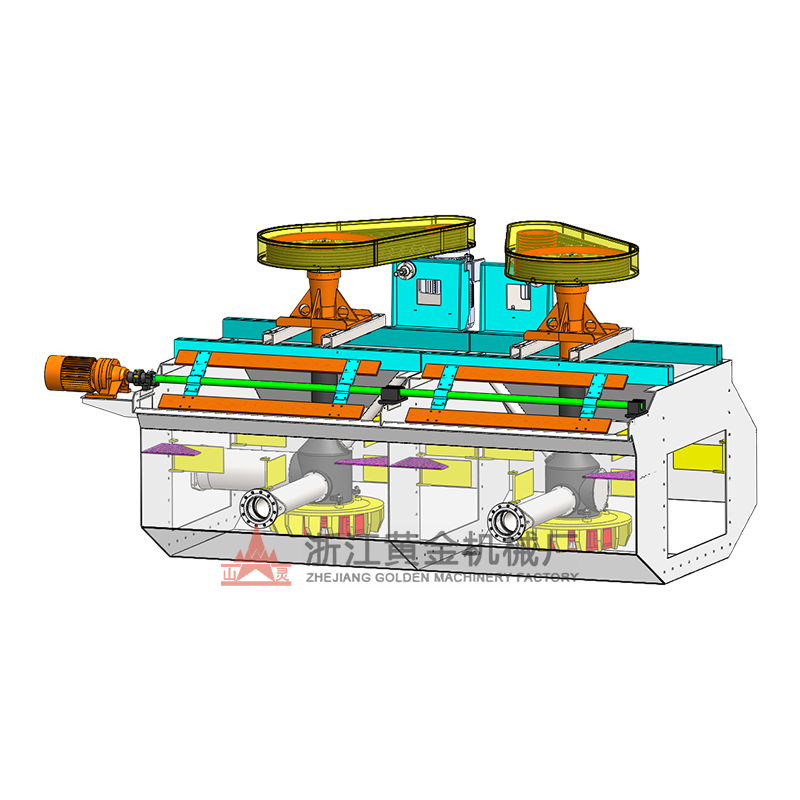
Different tank geometries and impeller styles are suited to different duties. The BF type flotation machine is a popular choice for copper roughing and scavenging circuits because of its self-ventilating mechanism and shallow tank design. The XCF/KYF type is a forced-air machine used when a high air flow rate is needed for large-scale production, especially in a plant with several large flotation lines. The JJF type, with its high-capacity design, is often selected for the final cleaning stage where limited froth volume is needed but selectivity is critical. The CLF type is designed for coarse-particle flotation, making it useful for ores where the copper mineral is coarse-grained and needs to be recovered without excessive grinding.
Flotation cell size has increased significantly over the past two decades. A modern copper plant may use 100 m³ or 200 m³ cells in the rougher circuit. Larger cells reduce the number of units, simplify instrumentation, and lower energy consumption per tonne of ore. But larger cells are also less forgiving of poor froth control, and they require well-designed dart valves and level control systems. The selection between self-aerated and forced-air machines is based on the ore feed consistency and the degree of control that the plant wants to maintain.
Apart from flotation equipment, a copper plant also needs classification, thickening, and pumping equipment. The classifier ensures a stable, fine feed to flotation, while the thickener controls both concentrate and tailings water balance. The role of flotation mining equipment in modern hydrometallurgy goes beyond simple separation; it includes providing a consistent feed stream that downstream leach circuits depend on for stable recovery.
Key Parameters in Flotation Optimization
Design determines what a flotation plant is capable of; operation determines what it actually achieves. The operating parameters covered in this section control the metallurgical results on a daily basis. For an engineer or a buyer evaluating a copper flotation project, knowing these parameters is the fastest way to judge whether a proposed process is reasonable.
Grinding Fineness
Grinding fineness is measured as the percentage of material passing 200 mesh. If the ore is ground too coarse, some copper mineral particles remain locked with gangue and cannot float. If it is ground too fine, the high surface area created consumes reagents and the fine particles are carried into the froth mechanically, diluting the concentrate. A typical porphyry copper ore is best floated at 60–70% passing 200 mesh, but a high-grade vein ore may require 75–80% passing 200 mesh for adequate liberation. A curve showing the relationship between fineness and recovery usually has a clear peak; finding that peak is the first task of a process optimization program.
Figure 1. Copper recovery tends to rise with grinding fineness, then falls as overgrinding produces slimes and reagent consumption increases.
Pulp Density
The solid-to-liquid ratio in the flotation feed is usually kept at 30–45% solids by weight. A denser pulp carries more copper mineral per unit volume, which increases retention time efficiency but also increases the risk of viscosity effects and poor bubble transport. A thinner pulp gives better selectivity and froth quality, but lower throughput for the same cell volume. In practice, rougher circuits operate at higher density, while cleaner circuits are diluted to 30–40% solids to maximize grade.
pH and Lime Addition
Lime is the most common pH modifier in copper circuits. The target pH in the rougher is usually between 9.5 and 11.5, where pyrite is depressed and copper minerals still float efficiently. The presence of pyrrhotite or other acid-consuming gangue changes the lime demand, so the pH control loop must be tight and responsive. A well-instrumented plant uses an online pH analyzer on the conditioner feed and a control valve on the lime line to hold the set point within ±0.2 pH units.
Air Flow and Impeller Speed
The aeration rate controls the number and size of bubbles in the flotation cell. Too little air reduces the superficial bubble surface area and lowers recovery; too much air causes a downward flow that carries particles back to the bottom and can tear the froth flat. For a self-aerated machine, the impeller speed directly controls the amount of air drawn in. For a forced-air machine, the blower output is separately regulated. A typical copper rougher circuit uses an air flow of 0.8–1.5 m³/m²/min, depending on the cell duty.
Froth Depth and Scraper Speed
Maintaining a stable froth layer is essential for producing a clean concentrate. A deeper froth (300–600 mm) provides more drainage of entrained gangue and gives a higher grade, while a shallower froth increases recovery but lowers grade. Scraper speed governs the rate at which froth is removed; if scrapers run too fast, they drag gangue-laden froth into the launder; if they run too slow, the froth may collapse and return to the pulp.
Common Operational Problems and How to Fix Them
Every copper flotation plant has bad days, and the causes are not always obvious. The guidance below combines common symptoms with their typical causes and corrective actions. The response time matters; waiting four hours for an assay to confirm a problem can cost more than changing the reagent dosage in real time based on froth observation.
Low copper recovery
Causes
Insufficient collector; overgrinding; slime coating on mineral surfaces; froth too shallow.
Actions
Increase collector dosage stepwise; reduce mill feed rate; add dispersant; adjust froth level and air flow.
Low concentrate grade
Causes
Pyrite activation; excessive frother; high entrained gangue; insufficient cleaning stages.
Actions
Raise pH with lime; reduce frother dosage; reduce scraper speed; add a cleaner stage or dilute cleaner feed.
Froth too stable or brittle
Causes
Frother type and dosage are mismatched with water chemistry; water hardness changes; clay content in feed.
Actions
Switch to a more selective frother; adjust dosage; use a defoamer when excessive; monitor process water quality.
Sand settlement in flotation cells
Causes
Impeller speed too low; pulp too thick; large particle size; worn stator or impeller.
Actions
Increase impeller speed; reduce feed density; check classifier cut size; inspect impeller and stator clearance.
High tailings grade
Causes
Liberation problem; insufficient residence time; short-circuiting; wrong reagent suite.
Actions
Re-examine grind size; check cell arrangement for channeling; add a scavenger cell; review mineralogy of the tailings.
Equipment Procurement Checklist for a Copper Flotation Line
Putting together a flotation line for a new copper project, a plant expansion, or a complete process modernization involves much more than publishing a list of desired volumes and requesting quotes. Buying flotation equipment is a decision about process performance, operating cost, and after-sales support. A structured checklist helps avoid the most common procurement mistakes.
Confirm the Ore Type and Grind Size
The flotation equipment must be competitive for the specific ore that the plant will treat. A sulfide ore that is ground to 65% passing 200 mesh has different residence time requirements than an ore that produces a large amount of primary slimes. Ask the equipment supplier to calculate required cell volume based on the project's flotation kinetics, not just on an approximate rule of thumb. A plant treating a fine-grained ore needs larger or more rougher cells than one treating a coarse-grained ore.
Assess Energy and Maintenance Costs
A flotation machine's power consumption depends on the impeller diameter, rotor speed, and tank size. Self-aerated machines are generally simpler and cheaper to operate than forced-air machines, but forced-air machines provide more direct air control, which improves recovery in variable feed conditions. Compare the total cost of ownership over at least seven years, including the cost of impeller and stator replacements, motor servicing, and instrument calibration. Do not choose the cheapest machine solely because of its purchase price.
Check Spare Parts and Local Support
The delivery of spare parts is often the bottleneck that stops a plant. When evaluating a machine, ask the manufacturer for a recommended stock list and compare local warehouse availability. The ability to deliver impellers, stators, dart valves, and level sensors within a short time matters more than any performance feature when the plant is down.
Insist on a Site Test or Pilot Trial
If the project is a new ore deposit or a major process change, insist on a pilot-scale flotation test using the actual ore sample. A simple batch flotation test on 1–2 kg of ore is useful but cannot assess froth behavior over a continuous period. A pilot plant run of several days on a few hundred kilograms of ore provides data on residence time, froth stability, and equipment wear that cannot be obtained from a batch test.
Verify the Supplier's Manufacturing Capability
Capability is about manufacturing experience and engineering integration. A flotation machine is a heavy-duty unit that must operate continuously under abrasive slurry conditions, with a design life measured in decades. The supplier's history with similar projects, their ability to meet delivery deadlines, and the quality of their test and manufacturing processes should all be checked. A factory visit is recommended if the project scale justifies the effort.
For buyers who are preparing a complete copper flotation plant, the decision includes not just the flotation cell itself, but the grinding, mixing, and dewatering equipment that forms the entire production circuit. Ordering an entire line from a single factory reduces interface risk, shortens commissioning time, and makes after-sales cooperation much simpler.
Frequently Asked Questions About Copper Flotation
What is the main purpose of copper flotation?
The purpose is to separate copper minerals from waste rock so that a relatively high-grade concentrate is delivered to the smelter. It raises the copper content from below 1% in typical sulfide ore to about 20–30% in concentrate, making smelting economically viable and minimizing the amount of waste transported away from the mine site.
How long does copper flotation take?
The residence time of the pulp in a copper flotation circuit is normally 10–20 minutes, distributed among rougher, scavenger, and cleaner cells. The conditioning time ahead of flotation is additional, typically 2–10 minutes. The total time from grinding to final concentrate may be several hours, but the active flotation period itself is short.
Can copper oxide ore be treated by flotation?
Yes, but only after a sulfidization step that forms a thin sulfide film on the oxide mineral surface. This step is sensitive and requires careful control of the sodium sulfide dose. If the oxide ore contains a high fraction of chrysocolla or other copper silicates, direct acid leaching is often a better option than flotation.
Why is lime added in copper flotation?
Lime is added primarily to raise and hold the pulp pH at a level where pyrite and other iron sulfides are depressed. Lime also precipitates some heavy-metal ions in process water and helps maintain a clear separation between copper and iron sulfides. In most copper sulfide circuits, the pH target is between 9.5 and 11.5.
What is the difference between a rougher and a cleaner flotation cell?
A rougher cell produces the first concentrate from the feed slurry and usually recovers the bulk of the copper mineral. A cleaner cell re-floats this concentrate to remove entrained gangue and raise the final grade. In a large plant, rougher cells are bigger and fewer, while cleaner cells are smaller and arranged in one to three consecutive cleaning stages.
How is flotation recovery measured on site?
Recovery is calculated from the assay of the feed, concentrate, and tailings on a given shift or day, with the formula based on the weight distribution that balances the three streams. Online X-ray analyzers provide near real-time assays every few minutes, allowing operators to respond quickly to a drift before the cumulative loss becomes significant.



