
 EN
 English
 русский
 简体中文


Mechanical vs column flotation cells: the direct answer
A mechanical flotation cell creates bubbles with a rotating impeller and a rotor-stator assembly. A column flotation cell creates bubbles with a sparger and uses a tall, open vessel with counter-current slurry flow and, in most duties, froth wash water. That is the practical difference: one uses rotating shear to disperse air and keep solids suspended; the other uses height, bubble rise and washing to separate particles.
Both designs can produce a saleable concentrate. The choice depends on liberation size, feed grade, clay content, required concentrate grade, circulating load, building height, operator skill and maintenance resources. A mechanical cell is usually the more forgiving workhorse for roughing and scavenging. A column cell is often the better cleaner when entrainment control and froth washing matter more than per-unit volume throughput.
Mechanical cell: the plant workhorse
Rotor-stator shear disperses air, suspends coarse and dense solids, and tolerates variable feed. It fits roughing, scavenging and many cleaning duties where a stable, high-volume circuit is needed.
Column cell: the selective cleaner
Deep froth and wash water reduce gangue entrainment. It suits fine liberated minerals and final cleaning duties, but it needs good feed preparation, stable level control and sufficient building height.
| Item | Mechanical flotation cell | Column flotation cell |
|---|---|---|
| Bubble source | Impeller and rotor-stator shear, with induced or forced air | Sparger, with compressed air introduced at the lower section |
| Solids suspension | Strong agitation keeps coarse and dense particles in suspension | Relies on upward slurry velocity and feed preparation; coarse particles can settle |
| Froth washing | Limited wash water application; entrainment controlled by froth depth, reagents and stages | Wash water is a normal design feature and can reduce gangue entrainment |
| Typical duty | Roughing, scavenging, primary cleaning and duties with variable feed | Cleaning, fine-particle separation and duties where concentrate grade is critical |
| Footprint and height | Larger floor area, lower height, easier access for maintenance | Smaller floor area, greater height, more attention to pump head and building layout |
| Control demand | Robust response to feed changes; rotor speed and air rate are key variables | Needs stable air, level, wash water and froth depth control |
| Main wear points | Rotor, stator, wear plates, seals and bearings | Sparger, pump, valves, wash water system and level instruments |
How bubble generation changes the flotation environment
The impeller in a mechanical cell does more than spin. It breaks air into bubbles, creates local turbulence, throws slurry against the stator and keeps particles moving through the cell. The result is a broad bubble-size spectrum and a vigorous mixing zone. Coarse particles are less likely to settle, and feed fluctuations are absorbed by the volume and agitation of the cell.
A column cell separates the functions. Air is introduced through a sparger, often at the bottom of the vessel, and bubbles rise through a slurry column. There is no impeller creating the same shear field. Bubble size depends on sparger design, air rate, frother and coalescence. The rising bubble swarm meets a descending slurry stream, which creates the counter-current contact that gives the column its name.
This difference matters at the particle scale. Mechanical cells are often more tolerant of composite particles and coarse liberation because the agitation helps keep particles in contact with bubbles. Column cells can be more effective for fine particles because the quiescent rising zone and deep froth give slow-floating particles more time to attach, while wash water reduces the mechanical entrainment of fine gangue.
Selection point
Do not compare cells by tank volume alone. A mechanical cell and a column cell of the same nominal volume do not have the same mixing pattern, residence-time distribution or froth environment. Compare them by duty, testwork recovery, concentrate grade and operability.
Froth washing, entrainment and selectivity
Froth washing is often the reason a column cell enters a flowsheet. Wash water is added near the top of the froth zone. It helps displace slurry and entrained gangue from the froth, while the rising bubble network drains and stabilises. In a cleaner duty, this can lift concentrate grade without relying entirely on additional cleaning stages.
A mechanical cell can also produce a high-grade froth, but the mechanism is different. Froth depth, reagent dosage, aeration, pulp density and bank arrangement do most of the work. Wash water may be used, but the agitated pulp and froth structure make control less direct than in a column. If a mechanical cell is pushed too hard for grade, recovery can fall; if it is pushed for recovery, entrainment may rise.
Wash water is not a free improvement. Too little wash water gives poor grade control. Too much can chill the froth, collapse bubbles, dilute the concentrate or reduce recovery. Water quality also matters: fine solids, oil and excessive hardness can affect froth stability. A column should be designed with a measurable wash-water range, not a single fixed setting.
Where columns show value
Fine-grained ores, final cleaners, graphite and talc circuits where gangue entrainment is costly, and plants with stable feed and good instrumentation.
Where mechanical cells stay stronger
Coarse feeds, high solids, dense minerals, variable ore blends, roughing duties and plants that need simple, robust operation with fewer control loops.
Residence time, throughput and plant footprint
A column cell trades floor space for height. The vessel is tall and relatively narrow, so it can fit into a compact plant footprint, but it needs a building or structural frame that can accommodate the height, feed pump head, wash-water header and maintenance access. Mechanical cells are shorter and wider. They need more floor area, but they are easier to place under a standard roof and easier to service with a crane.
Residence time is not simply a matter of volume. Mechanical cells have a wide residence-time distribution because of mixing and short-circuiting. Column cells often provide a more plug-flow-like rise path, which can help slow-floating particles. However, a column with poor feed distribution, unstable level or excessive downward velocity can lose that advantage.
Height
Columns need vertical space; mechanical cells need more plan area.
Volume
Nominal volume alone does not compare performance; mixing pattern matters.
Turndown
Mechanical banks often handle wider feed-rate swings without immediate upset.
Agitation, solids suspension and coarse-particle duty
Mechanical cells are usually the first choice for coarse or dense particles because the impeller keeps the pulp in motion. A well-designed rotor-stator creates enough upward velocity and turbulence to suspend solids without destroying the froth. This matters in ores containing heavy sulphides, magnetite, coarse liberated gangue or high-specific-gravity minerals.
A column has no impeller. Solids stay suspended through feed velocity, bubble action and the hydraulic design of the vessel. If the feed contains coarse particles, the upward velocity may be insufficient, and the lower zone can sand up. Feed dilution, classification and the use of a mechanical rougher ahead of the column are common ways to protect column performance.
In practice, many plants use a hybrid circuit: mechanical cells for roughing and scavenging, followed by column cells for cleaning. The mechanical cells handle the coarse and variable part of the feed; the column receives a cleaner, finer feed where wash water and deep froth can improve grade. That arrangement can be more robust than forcing one cell type to do every duty.
Control, instrumentation and operator workload
A mechanical cell is relatively tolerant of operator variation. The main variables are pulp level, air rate, rotor speed, froth depth and reagent addition. If the feed changes, the cell often keeps working while the operator adjusts. This is one reason mechanical banks remain common in roughing and scavenging duties.
A column cell asks for tighter control. Air flow, slurry level, wash-water flow, froth depth, feed density and bubble interface all interact. A small change in wash water can alter grade and recovery. A level instrument that drifts can cause froth overflow or loss of the froth zone. The column can perform well, but it rewards instrumentation and attention.
That does not mean a column must be complicated. It means the control philosophy should be defined before purchase: which variables are automatic, which are manual, what happens on air failure, how the wash-water header is balanced and how the operator detects sanding or sparger blockage. A robust mechanical bank is not automatically easier to optimise, but its failure modes are often easier to see and correct.
Energy, wear parts and maintenance
Mechanical cells consume energy through impeller rotation and air supply. The wear parts are concentrated in the rotor, stator, wear plates, seals and bearings. Maintenance access is usually direct: remove the mechanism, inspect the wear surfaces and replace components. The cost is predictable, but downtime can be significant if the mechanism is not designed for easy lifting.
Column cells consume energy through compressed air and feed or circulation pumps. The sparger is a critical wear point. Fine solids, scale and poor air quality can block sparger holes, creating uneven bubbles and dead zones. Pumps, valves and wash-water distribution systems also need attention. A column with a blocked sparger may look stable at the control panel while performance quietly falls.
Mechanical cell maintenance
Rotor and stator inspection, bearing condition, seal leakage, wear plate clearance, air pipe condition and mechanism alignment.
Column cell maintenance
Sparger cleanliness, air distribution, level instruments, wash-water nozzles, froth overflow lip, pump performance and valve response.
Spare-parts planning
Keep critical wear parts for the selected design. A low purchase price is not useful if a sparger or rotor has a long lead time.
Circuit design: roughing, scavenging and cleaning
Most flotation circuits do not need a single cell type everywhere. Mechanical cells are often used for roughing because they handle high tonnage, coarse particles and variable feed. Scavenging also suits mechanical cells because the objective is recovery from lower-grade pulp, and the duty tolerates more mixing. Cleaning is where column cells often earn their place, especially when final concentrate grade and entrainment control are important.
A hybrid circuit can also reduce risk. The mechanical section provides a stable buffer against feed changes; the column section provides a final selectivity step. The key is to design the interface properly: the column feed should be de-slimed or diluted as required, the froth handling should match the column overflow, and the mechanical cells should not send a coarse, unstable feed to a column that cannot suspend it.
Upgrade projects often reveal this logic. A plant may keep existing mechanical roughing cells and add column cleaning to improve grade, or replace an inefficient cleaner bank with a column while retaining mechanical scavengers for recovery. The evaluation should include mass balance, liberation, froth stability and the cost of pumps, piping and building modifications. A published example is the 3000 t/d zinc flotation retrofit, where circuit changes must be judged against existing equipment, feed variability and concentrate requirements.
Selection matrix by ore and duty
The matrix below is a starting point for engineering discussion, not a substitute for testwork. The most common error is to choose a cell type from a single recovery number without checking concentrate grade, feed size, clay content, turndown and maintenance access.
| Process condition | Mechanical cell fit | Column cell fit |
|---|---|---|
| Coarse liberation, dense minerals | Strong fit; agitation keeps particles suspended | Use with care; feed preparation and upward velocity must be verified |
| Fine liberated particles, high gangue entrainment | Possible, but may need more cleaning stages | Strong fit when wash water and froth depth are controlled |
| Roughing at high tonnage | Common choice; robust and tolerant | Less common; taller layout and tighter control may not suit roughing |
| Final cleaning for grade | Can work with staged cleaning and reagents | Often preferred for entrainment control and froth washing |
| Variable ore blend and feed rate | Good turndown and forgiving operation | Requires stable feed and well-tuned control |
| Limited floor area, sufficient height | Requires more plan area | Compact footprint but needs vertical space |
Procurement checklist for plant projects
A flotation purchase should start with a duty statement, not a tank size. Define the feed size distribution, solids concentration, design tonnage, expected grade and recovery, reagent scheme, froth characteristics and the required turndown. Then ask each supplier to explain how the proposed cell handles those conditions.
Testwork
Require locked-cycle or pilot work that reports grade, recovery, mass pull and sensitivity to feed rate. A single batch test is not enough for a column or a large mechanical cell.
Hydraulics
Check feed pressure, pump head, wash-water range, froth overflow height, launder capacity and the effect of design slurry density.
Layout
Confirm crane access, maintenance platforms, sparger removal space, rotor lifting height, pipe routing and the building height available.
Control
Agree on the control philosophy, instrument list, fail-safe positions, alarm setpoints and operator interface before shipment.
Wear parts
Ask for a wear-part schedule with expected inspection intervals, lead times and the minimum recommended spares holding.
Commissioning
Include installation supervision, operator training and a performance test with clear acceptance criteria and measurement methods.
For a column, add specific questions about sparger type, air quality, wash-water distribution, froth depth measurement and sanding prevention. For a mechanical cell, ask about rotor-stator clearance, air induction method, mechanism support, seal design and the maximum solids size the cell can keep in suspension. These details decide whether the equipment will meet the flowsheet after commissioning.
Product fit and mechanical flotation options
Zhejiang Golden Machinery builds mechanical flotation equipment for roughing, scavenging and cleaning duties, with models selected according to volume, air demand, solids characteristics and circuit layout. The BF-type flotation machine is a common choice for duties that need reliable air dispersion and robust rotor-stator operation. It suits many base-metal and non-metal flotation circuits where feed conditions vary and maintenance access must remain practical.
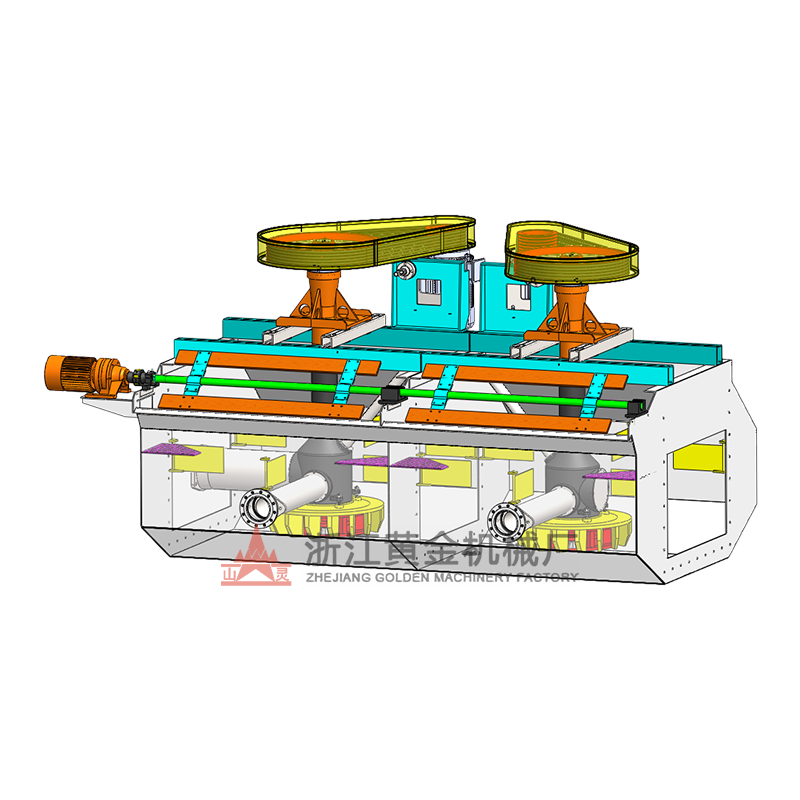 BF-Type Mechanical Flotation Machine for Mineral ProcessingSelf-aspirating mechanical cell with closed double-cone impeller and strong slurry circulation, available in 0.15–24 m³ models for roughing, scavenging and cleaning duties.View Product →
Where a project needs higher air dispersion and a more controlled pulp circulation pattern, the XCF/KYF-type flotation machine is often considered. These cells can be arranged in banks for roughing and scavenging, and the selection between cell variants should follow testwork, air requirement and the desired froth behaviour. A detailed BF versus KYF/XCF comparison helps separate structural differences from process differences.
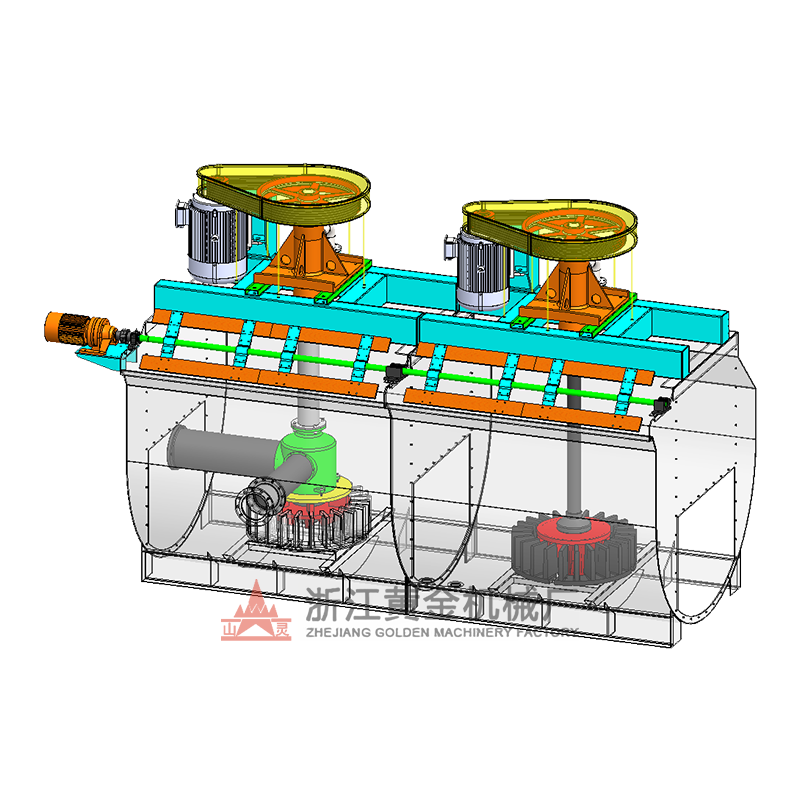 XCFII/KYFII Combined Flotation Machine for Horizontal CircuitsCombined suction and direct-current cells for horizontal flotation circuits, offering controlled pulp circulation and air dispersion in roughing and scavenging.View Product →
The JJF-type flotation equipment is another option for plants that prioritise simple operation and stable performance in conventional duties. Final selection should consider the full bank, not only one cell: feed box design, pulp level control, froth launder arrangement and the interface with the next stage all affect recovery. For column cleaning duties, mechanical cells can remain in roughing and scavenging, which keeps coarse material out of the column and protects its froth environment.
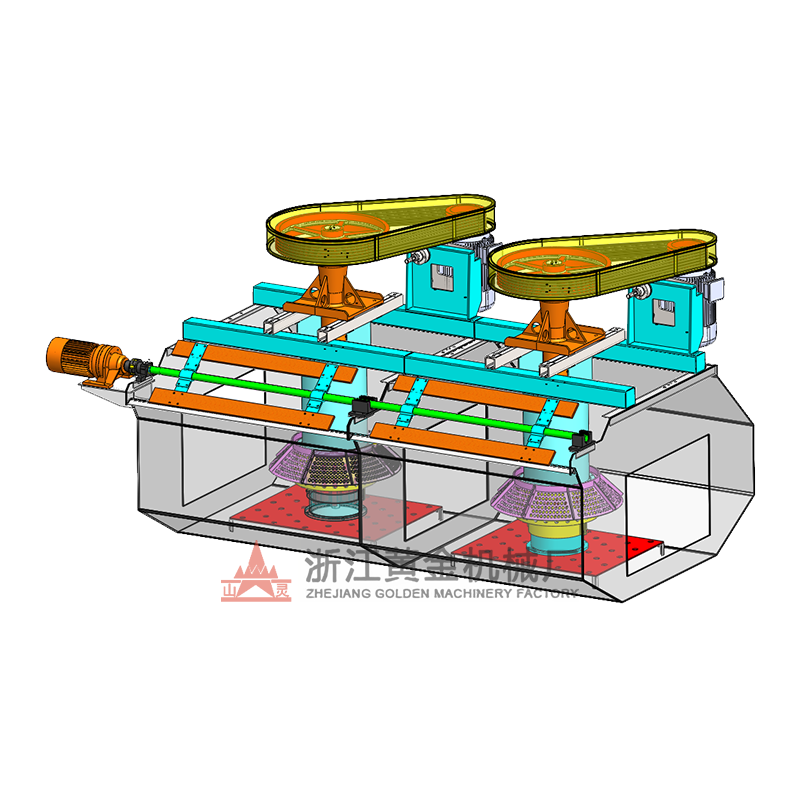 JJF-Type Self-Aspirating Mechanical Flotation EquipmentSelf-aspirating mechanical cells with deep star impeller and large lower-tank circulation, suited to conventional duties where simple operation and stable performance matter.View Product →
Installation, commissioning and common failure points
Mechanical cells need a level foundation, correct mechanism alignment, unobstructed air supply and enough access for rotor and stator removal. The launder must handle the design froth volume, and the feed box should distribute slurry without short-circuiting. During commissioning, check impeller rotation, air rate at each cell, pulp level response and froth carry-over before increasing tonnage.
Column cells need particular attention to vertical alignment, feed distribution, wash-water headers and froth overflow. The feed must enter below the froth zone without creating a jet that disturbs the interface. Air must be clean and evenly distributed. Level instruments should be calibrated against visual froth depth, not only the control screen. If the column sands up, the cause is often insufficient upward velocity, coarse feed, unstable air or a blocked sparger.
Common failure points are predictable. Mechanical cells show worn rotor-stator clearance, leaking seals, bearing vibration and uneven air distribution. Column cells show sparger blockage, wash-water nozzle plugging, level control drift, pump surging and froth over-stabilisation. A preventive maintenance plan should list inspection frequency, acceptance tolerances and the spare parts needed to avoid extended downtime. The plan should be ready before the first feed is introduced, not after the first upset.
Frequently asked questions
Is a column flotation cell always better for concentrate grade?
No. A column can improve grade when froth washing and deep froth suit the ore, but it can underperform if the feed is too coarse, the wash water is poorly controlled or the level instruments are unreliable. Mechanical cells with staged cleaning can also achieve high grade when the reagent scheme and froth depth are optimised.
Can a mechanical cell replace a column in a cleaning circuit?
In some plants, yes, especially when the ore is coarse or the cleaner feed is variable. The trade-off is usually more cleaning stages, higher circulating load or greater reagent consumption. The comparison should be based on locked-cycle testwork and the cost of the full circuit, not only the cell price.
What is the main operating risk with a column cell?
Sanding and unstable froth control are common risks. A column depends on upward velocity, clean air, stable feed density and reliable wash water. If any of these drift, the froth zone can become unstable or the lower zone can accumulate solids. Instrumentation and operator attention are part of the design, not optional extras.
What is the main operating risk with a mechanical cell?
Wear on the rotor, stator and seals, plus loss of air dispersion if the mechanism is poorly maintained. Mechanical cells are forgiving, but they are not maintenance-free. Clearance checks, bearing monitoring and air-rate verification should be part of the routine.
Which cell type uses more water?
A column normally uses wash water in the froth zone, so it has a specific water demand that a mechanical cell may not have. The total water balance depends on the circuit, feed density and concentrate handling. Wash water must be available at the required pressure and quality; otherwise the column may not deliver the expected grade benefit.
Can mechanical and column cells be used in the same circuit?
Yes. A common arrangement is mechanical roughing and scavenging followed by column cleaning. This uses the mechanical cells to handle coarse, high-tonnage and variable feed, while the column receives a cleaner feed where wash water and froth depth can improve selectivity. The interface between the two sections must be designed carefully.
What testwork is needed before choosing?
Use representative samples and test the intended duty, not just a standard batch flotation. Report recovery, concentrate grade, mass pull, kinetics and sensitivity to feed rate, pulp density and reagent addition. For a column, include wash-water rate and froth depth in the test programme. For a mechanical cell, include rotor speed, air rate and solids suspension behaviour.
How should a plant compare supplier proposals?
Compare duty performance, not only tank volume or price. Check the proposed residence time, air supply, wash-water system, control philosophy, wear-part schedule, installation requirements and commissioning support. Ask for the basis of scale-up and the range of operating conditions the design can tolerate. A proposal that cannot explain its scale-up assumptions is difficult to evaluate.



