
 EN
EN
 English
 русский
 简体中文
简体中文

Mineral processing starts from one controlling idea: valuable minerals must be separated from worthless gangue before any recovery method can work. Crushing reduces rock in stages, but grinding liberates individual mineral grains and creates the surface area that flotation reagents and leach solutions depend on. So what grinding machine is used in mineral processing? No single machine fits every ore; the right choice depends on the ore, the tonnage, and the process that follows.
Why Grinding Is a Critical Step in Mineral Processing
Grinding performs two essential tasks. It liberates valuable mineral grains from the surrounding rock so downstream separation can isolate them, and it increases surface area, which accelerates leaching and improves contact with flotation reagents. Both effects set the recovery the plant can achieve.
The economic weight is large. Grinding consumes more electricity than any other unit, often 30 to 50 percent of plant power, and media and liner wear add significant operating cost. A poorly selected mill suppresses flotation recovery, raises reagent consumption in leaching, and widens concentrate grade variability.
Grinding also sets the flowsheet's upper limit. Product too coarse sends composite particles to tailings; product too fine creates slimes that degrade flotation and slow thickening. Consistent feed matters, which is why reliable ore feeding equipment, such as a channel-type feeder, is specified together with the mill.
The Main Types of Grinding Machines Used in Mineral Processing
Grinding machines in mineral processing are classified primarily by grinding medium. Four families cover nearly every application: ball mills, rod mills, autogenous and semi-autogenous mills, and specialist machines such as stirring mills and high-pressure grinding rolls.
Ball Mills — The Workhorse of Ore Grinding
The ball mill is the most common grinding machine in mineral processing. A rotating cylindrical shell is partially filled with steel balls; as the shell turns, lifters raise the balls and release them in a cascade, breaking ore by impact while finer particles are ground by attrition, the wearing down of material by friction. Construction is simple: a shell, replaceable liners, steel balls, and a drive system. Ball mills can run wet or dry, but the wet configuration dominates because the slurry pumps easily and feeds directly into flotation or leaching.
By discharge arrangement, ball mills split into two families. The grid type has a perforated discharge grate that holds back media and coarse particles, so the mill runs at a lower pulp level and delivers coarser product at higher throughput, making it the natural first-stage grinder. The overflow type discharges through a hollow trunnion, runs at a higher pulp level, and produces a finer product for regrinding and fine grinding.
A copper concentrator in Anhui illustrates the standard flowsheet: a wet grid type ball mill in closed circuit with a spiral classifier reduces ore to about 70 to 75 percent passing 200 mesh before rougher flotation.
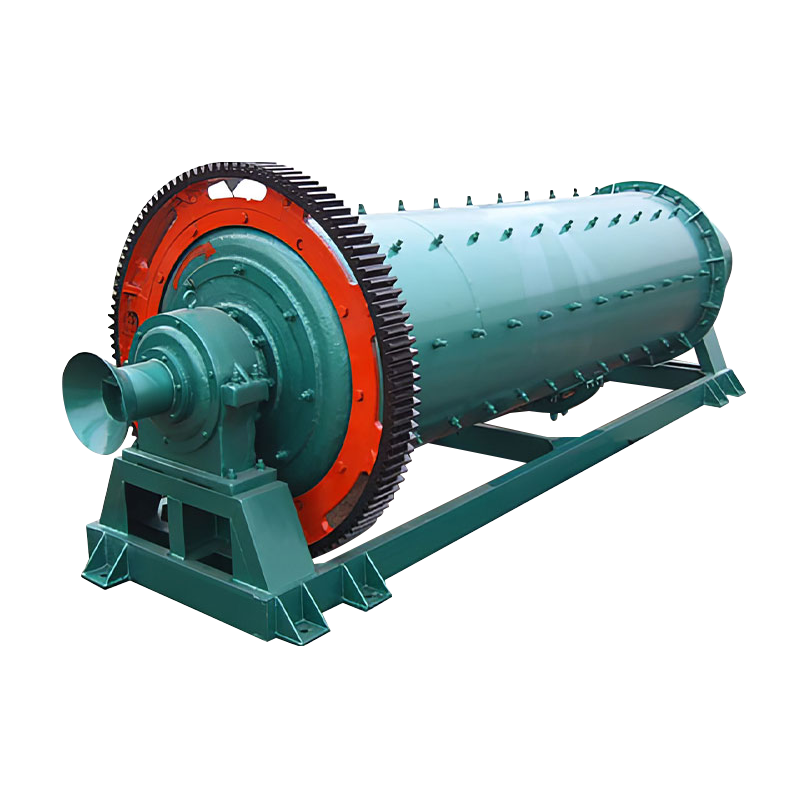 Mineral Ball Mill Manufacturers, Mineral Ball Mill FactoryZhejiang Golden Machinery Factory is China Mineral Ball Mill Manufacturers and Mineral Ball Mill Factory, offer Custom Wet Grid Type Ball...View Product →
Rod Mills — For Coarse Grinding and Uniform Product Size
Rod mills use long steel rods lying parallel to the mill axis. Because the rods grind by line contact, the product has a narrower size distribution and fewer fines than a ball mill. That uniformity suits coarse grinding ahead of gravity circuits and first-stage milling before a ball mill. Rod mills remain common in medium and small plants, although large operations have largely replaced them with SAG mills.
Autogenous and Semi-Autogenous Mills
Autogenous mills use the ore itself as the grinding medium: large blocks of primary crushed rock tumble inside a large-diameter shell and break one another by impact. Semi-autogenous mills add a steel ball charge, typically 6 to 15 percent of mill volume, to handle ores that cannot grind themselves. AG and SAG mills accept feed up to about 300 mm and reduce it to a size that flotation or a ball mill can handle, eliminating secondary crushers and often a rod mill stage. The trade-off is sensitivity: AG mills need a narrow ore hardness range, and SAG mills demand careful circuit design. For plants below 3,000 tonnes per day, a ball mill circuit is usually the better economic choice.
Other Grinding Equipment: Stirring Mills and High-Pressure Grinding Rolls
Stirring mills, also called stirred media mills, rotate an agitator inside a stationary chamber to spin fine ceramic or steel beads. Grinding happens mostly by attrition, which makes them the standard for ultra-fine grinding below 20 microns. High-pressure grinding rolls squeeze ore between two counter-rotating rollers, creating microcracks that lower the energy demand of a downstream ball mill, although the units are capital-intensive and sensitive to feed consistency.
Wet Grinding vs Dry Grinding: Which Should You Choose?
In mineral processing, wet grinding wins by a wide margin. A wet mill produces a pumpable slurry that moves by gravity or pumps to the classifier, flotation cells, or leach tanks without extra conveyors. Wet grinding suppresses dust, reduces explosion risk with sulphide ores, and lets operators control pulp density. Dry grinding serves a narrower niche: materials that react with water, processes that require dry powder, or ores prone to clay swelling. The cost of dry grinding comes from dust collection, gas cleaning, and repulping the product for the next wet step. In a conventional concentrator, where flotation and leaching are wet by design, dry grinding adds cost without adding value. The table below summarizes the differences.
| Comparison Point | Wet Grinding | Dry Grinding |
|---|---|---|
| Slurry transport | Pumps and gravity flow | Mechanical conveyors and air classifiers |
| Dust and safety | Minimal dust; safe for sulphide ores | Bag filters and explosion protection |
| Downstream fit | Direct feed to flotation and leaching | Drying step needed before repulping |
| Typical applications | Base metals, precious metals, potash | Cement clinker, select industrial minerals |
The wet grid type ball mill is therefore the default grinding machine for most mineral processing plants. Its wet operation, grate discharge, and coarse-feed tolerance make it the natural choice for primary and secondary grinding.
How to Choose the Right Grinding Machine for Your Ore
Selecting a grinding machine is an engineering decision. The most dependable approach evaluates five variables: ore hardness, feed and product size, throughput, operating cost, and downstream process requirements.
- Ore hardness and grindability. The Bond work index, in kilowatt-hours per tonne, measures the ore's energy demand. Hard, abrasive ores favor ball mills with wear-resistant liners; very soft ores may justify rod or AG milling.
- Feed size and product size. Coarse feed suits rod or SAG mills; feed below about 10 mm is classic ball mill duty. Products above 150 microns suit rod or grid-type ball mills, 75 to 45 microns suits overflow ball mills, and anything below 20 microns needs a stirring mill.
- Throughput scale. Plants above about 10,000 t/d can justify SAG or HPGR circuits. The 500-3,000 t/d range, common for polymetallic and precious metal ores, is served most economically by a ball mill in closed circuit.
- Media and power cost. Steel ball consumption ranges from roughly 0.3 to 1.5 kg per tonne depending on ore abrasiveness, and electricity is usually the largest operating cost. Both belong in a life-of-project model.
- Downstream process interface. Flotation wants a grind that liberates values without creating slimes; leaching wants a grind that balances surface area against thickening and filtration cost.
For most medium-scale concentrators, the core train is a crusher, a ball mill in closed circuit with spiral classifying equipment, and a flotation section fed by the classifier overflow. The classifier controls final fineness and tightens the product size distribution even as ore hardness varies.
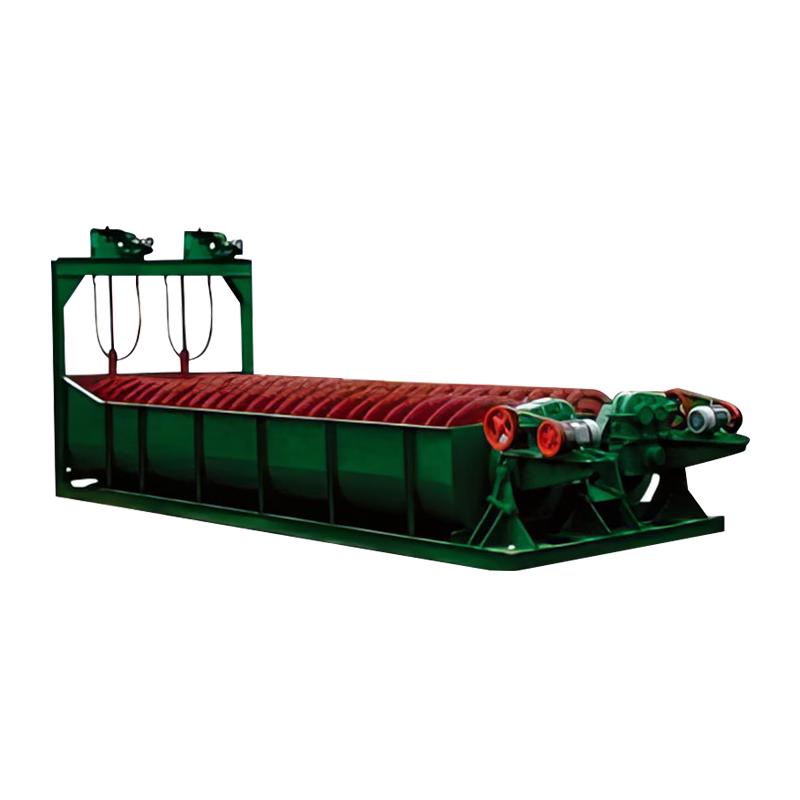 Custom Spiral Classifying Equipment Suppliers, OEM/ODM Factory - Zhejiang GoldenZhejiang Golden Machinery Factory is China Spiral Classifying Equipment Suppliers and OEM Factory, details:The main components of the spi...View Product →
Grinding Considerations in Hydrometallurgical Processes
Hydrometallurgical flowsheets, which recover metals by leaching instead of flotation, impose their own rules on grinding. The leach reaction occurs at the particle surface, so extraction rate depends directly on the surface area the mill creates. Oxide gold, copper, and weathered ore operations commonly target 80 percent passing 75 microns or finer, and the mill must hold that fineness with little variability.
Too coarse a grind leaves particle cores inaccessible to the leach solution, extending residence time and raising reagent consumption. Too fine a grind slows thickening, washing, and filtration, because fine solids settle slowly and retain soluble metal. The optimum is set by leach testing. The equipment chain is therefore designed as one system: mill discharge is conditioned and fed to agitated vessels such as a mechanical mixing leach tank, where residence time, pulp density, and air supply are matched to the particle size produced upstream. Potash and salt lake operations follow the same logic: grinding fineness is set by brine chemistry and leach kinetics, not by liberation alone.
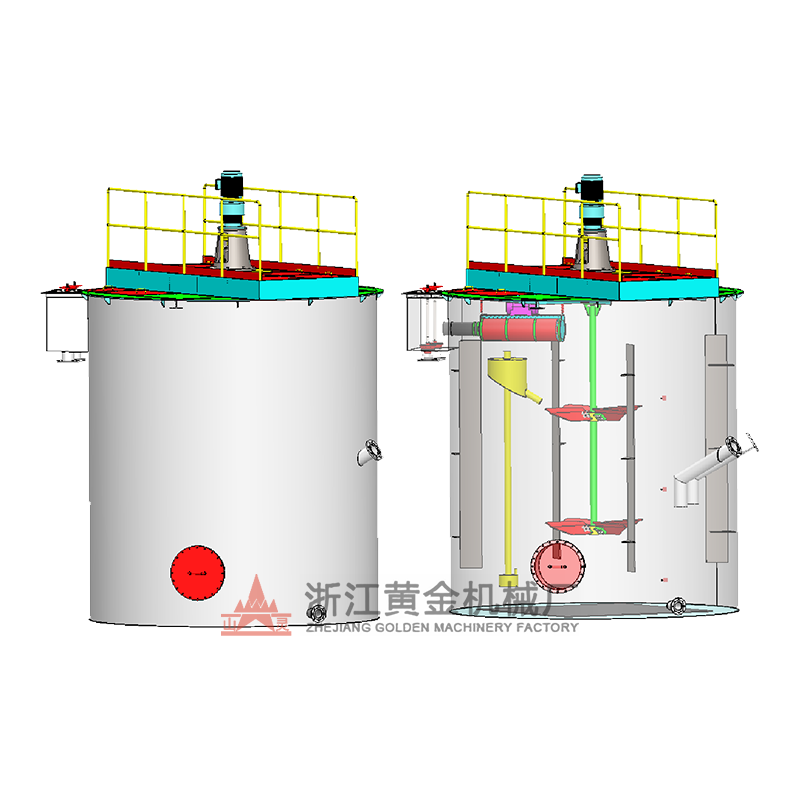 Custom Mechanical Mixing Leach Tank Suppliers, OEM/ODM Factory - Zhejiang GoldenZhejiang Golden Machinery Factory is China Mechanical Mixing Leach Tank Suppliers and OEM Factory, details:It is suitable for mechanical ...View Product →
Conclusion: Matching the Mill to Your Mineral Processing Goals
Every grinding machine in mineral processing solves a specific combination of ore, tonnage, and process requirements. Ball mills are the industry workhorses and cover the broadest range of duties. Rod mills deliver uniform coarse products where over-grinding matters. AG and SAG mills provide enormous capacity at the price of complexity. Stirring mills and HPGR handle ultra-fine grinding and energy-efficient comminution. For most plants in the medium to large class, wet grinding with a ball mill in closed circuit with a classifier remains the most reliable, economical, and controllable solution.
The decision path is short: measure ore hardness, define product fineness, set throughput, model media, power, and water costs, and review the full circuit — feeder, mill, classifier, and downstream tanks — as one system. If the next step is leaching, design the grinding fineness together with the leach tanks, because neither can be optimized alone.
A manufacturer that builds the mill, classifier, feeder, and leach tanks, and has delivered complete mineral processing projects, can translate process data into the right equipment combination. Start with grindability test results, feed size distribution, and product specification, and let the equipment follow.



